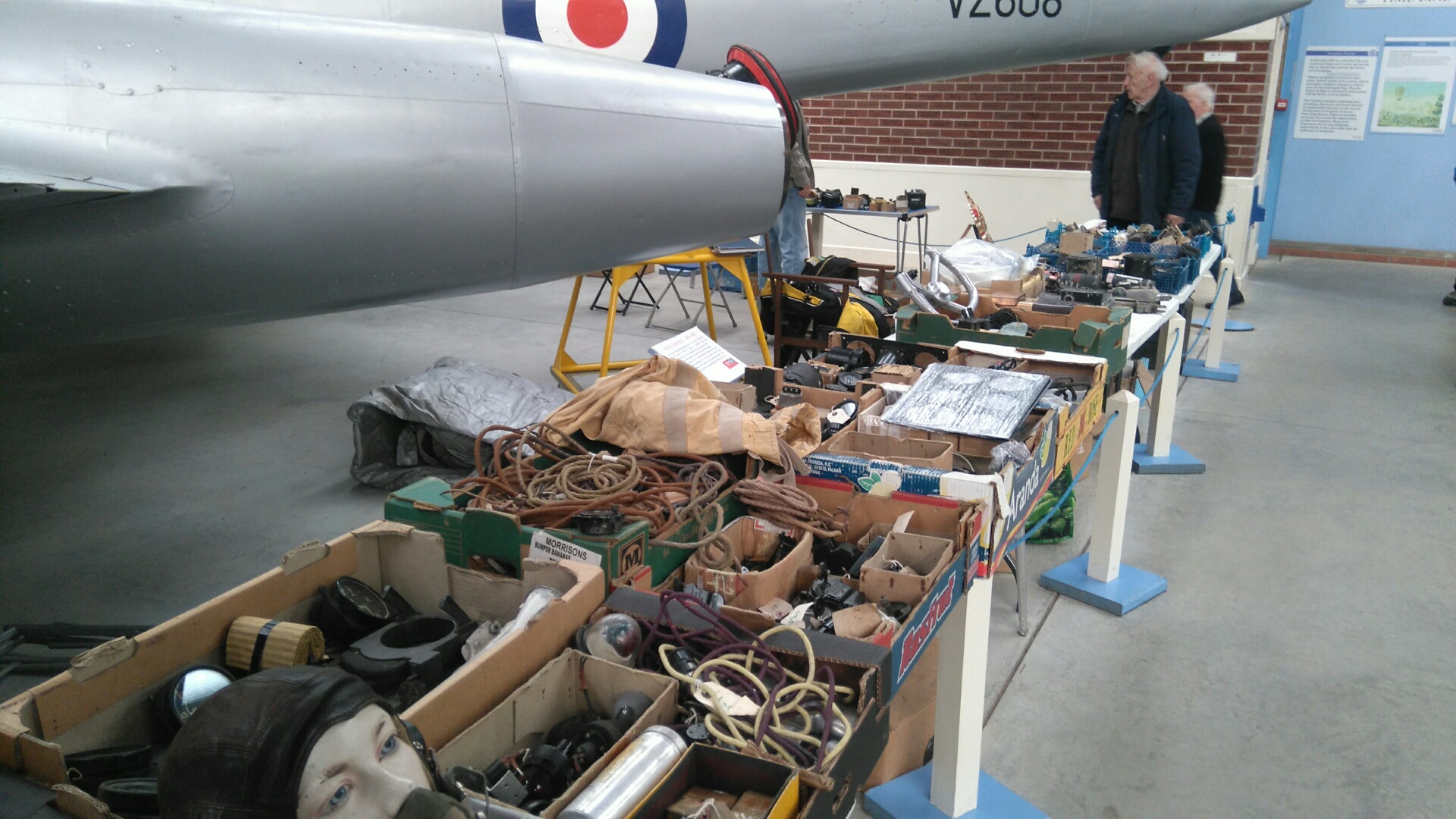
Newark Aero Jumble.

Standard

Up at the crack of dawn, I sped up the M1 to Newark this morning to catch the aerojumble at the air museum. I was convinced that someone would have a dusty square cardboard box with a new old stock Hercules piston! The ball joint from the sleeve I’d find in a box marked "miscellaneous – any item £5". I’d be driving home with all the parts I needed by half 10 🙂

It didn’t quite go down that way! I had a few detours on the way so I arrived later than I wanted. I was cursing my luck, imagining the bloke on the piston stall telling me he’d just sold a pair! As it turned out I needn’t have worried.

The jumble was interesting but mostly aircraft instruments and memorabilia. Some great stuff there and a friendly atmosphere, but it was fairly obvious that I wasn’t going to find anything on my list. I was all set to leave when I decided to make one last circuit and ask everyone, just in case.

Most of the stall owners had nothing, as I expected. But I did track down a gentleman who has three Hercules engines in various states! He was quite busy so I took his card and said I’d be in touch. It might come to nothing, but it’s always worth asking!
Draft plans

Standard

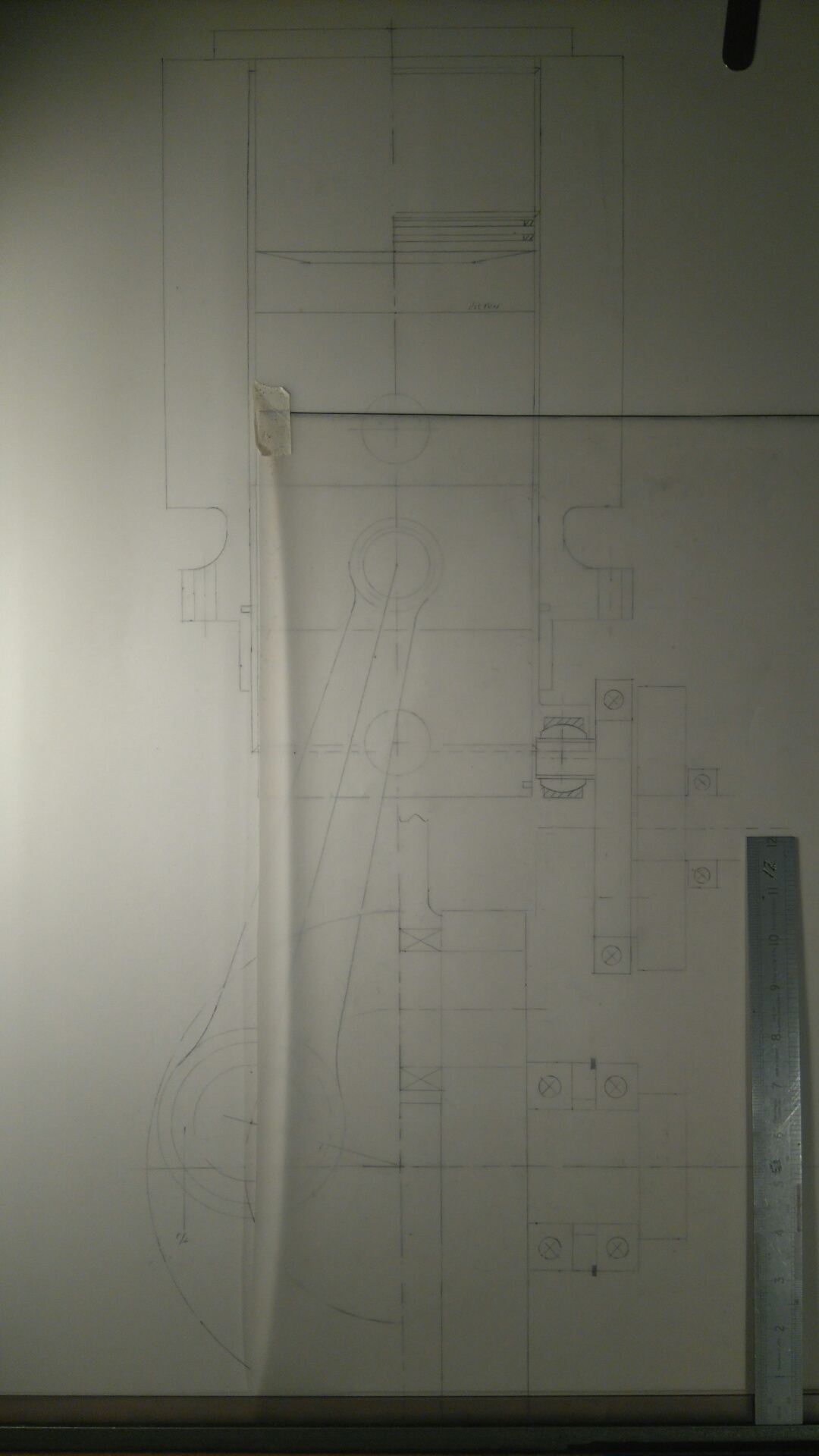
It might not look much, but a lot of thought and calculations have gone into producing this drawing. Bob has been hard at work putting the base dimensions together, working out the minimum rod length we can get away with to make a compact engine.

The rod length is critical as too short will have it colliding with the sleeve, but too long sees an unnecessarily tall engine. The clearance between the sleeve and flywheels is also critical, as I wanted to avoid having to chamfer them. For balance we now know that the maximum rod deflection happens 74 degrees either side of TDC.

A slight surprise to me is the overall height of the engine. Ok, so a 2.75 litre single is never going to be small, but the complete motor is looking like 30″ top to bottom. (or 75cm if you prefer). On the Dnepr outfit that puts the head level with the top of the tank!

But it’s still doable. In fact I like the fact it will look imposing, neat and different. All I need to do now is locate some parts!

dsc 0147

Clear Props!

Standard

Part of the upcoming Centenary celebrations for the RAF sees the most interesting exhibits being dug out and cleaned up for display. One of each type of Ejector set, one of each type of prop etc.. The spares were hanging on a scaffold pole and made quite a nice photo. What a shame that there isn’t the limitless space required to display it all for the public!

Then again, it would take a few weeks just to look around! I’m still smiling after my visit. 🙂

The RAF Museum Reserve Collection.

Standard

What an amazing place the RAF museum reserve collection is! It’s a real Aladdin’s cave for any aircraft or aero engine enthusiast. I was lucky enough to be allowed a visit in my quest for information on the Bristol Hercules engine and surviving examples. The collection is basically stuff that would normally be on display at various museums, but isn’t at the moment. Down to a lack of display space and the need to keep things interesting by varying the exhibits, they store a lot of stuff out of the way in the reserve collection. It’s not open to the public except by invitation.

I’d been in contact with the museum to see if I could source some drawings, or take direct measurements from a sleeve drive crank if they had one. They put me in touch with Ian Alder, manager of the collection. You couldn’t find a more helpful person! Ian invited me down and took time out of his day to show me all around. He seemed genuinely interested in my project and was able to put his hands on a crank for me to measure. Unfortunately there wasn’t an easy datum to measure from, so while I have an approximate value I’m still chasing a drawing. Ian was also able to help there with some contacts at Rolls-Royce Heritage, who may have some original drawings.

The collection is a mind blowing array of interesting and well preserved articles, particularly engines! How about a NEW Bristol Hercules in a crate, as delivered but never fitted? Or one removed from an aircraft still in the nacelle? Sitting right next to…. a Centaurus in nacelle as remove from another aircraft! How about a motorised cut-away Hercules then? It’s all there! I saw Gnome engines in crates, Rolls-Royce Eagle engines in housings – part of a replica Vickers vimy (the whole thing), a couple of Merlins (or Griffons maybe?), Pratt and Witneys…. The list goes on. Then there are lots of aircraft (complete but disassembled), ejector seats, lifeboats – you name it.

Very interesting indeed! The collection is well cataloged with exhibits all photo tagged and computer logged, so I don’t fancy my chances of getting any bits. But that’s not what it’s about. I was looking for information and fresh leads, and Ian was kind enough to provide them. Thanks very much!

More light reading….

Standard

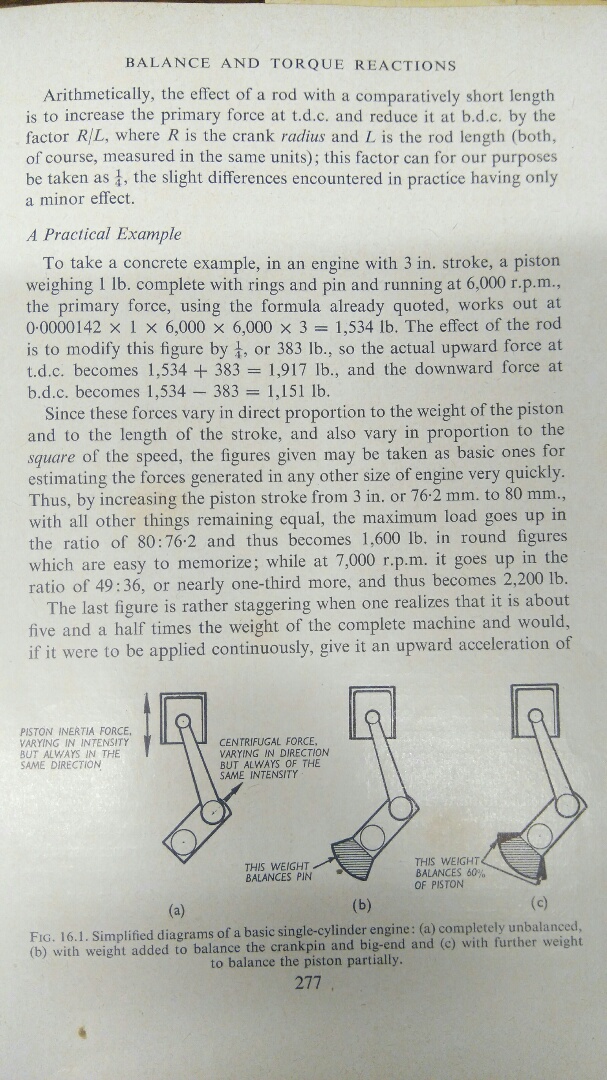
I returned to the section on balance in Mr Irving’s book to re-read the calculations. I will need to run them for my engine to help decide on the balance factors. At the moment I know the bore and stroke, but without a Piston I can’t weigh the reciprocating mass.

Unlike a conventional (poppet valved) engine, I also need to consider the weight of the sleeve. This is moving at half engine speed and through less distance. Around one third of the distance the Piston travels. However, the weight of the sleeve is significant compared to the piston, which at times will be moving with – or against it. Interesting engine to balance!

Rpm is definitely a factor, with imbalance forces rising in proportion to the square of the rpm. I know that the max rpm of the Hercules was 2880, and I considered that 3500 to 4000 would be my peak rpm. I guess the calculations will tell me once I know all the masses!

Off with ‘is head!

Standard

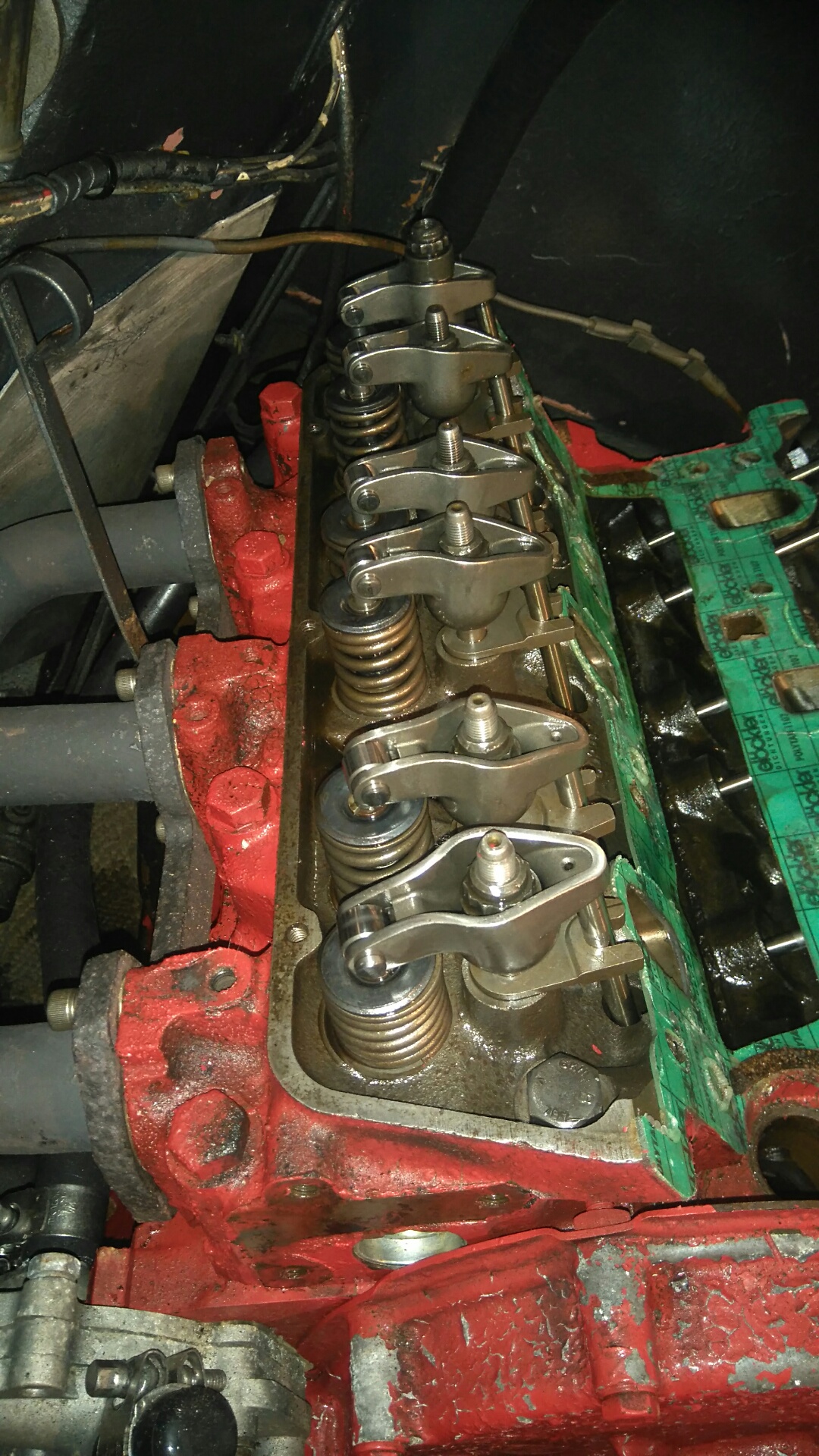
While I’m waiting to hear about availability for the Hercules bits I need, I’ve turned my attention to the Scimitar. The heads need to come off as the posts holding the rockers are being pulled out. They’re only an interference fit and unfortunately have started to move. I’ll get threaded inserts. I don’t mind the work, but I’m not really a car fan – I’d far rather be working on a bike.

Bob dropped some more light reading off the other day. I’m particularly interested in the balance factors different manufacturers used on their flywheels. Anything from 30 to 70%! The chapter on Balance and Torque reactions in P.E.Irving‘s Motorcycle Engineering book is fascinating! Though having said that, I’m no nearer to deciding what balance factors to apply.

I really like designing stuff, it’s so easy to make changes when you haven’t built anything yet!!

The photo shows the rockers on the Scimitar. I’ve fitted roller tipped rockers, which you don’t see that often. Nice aren’t they??

The Drawing Board.

Standard

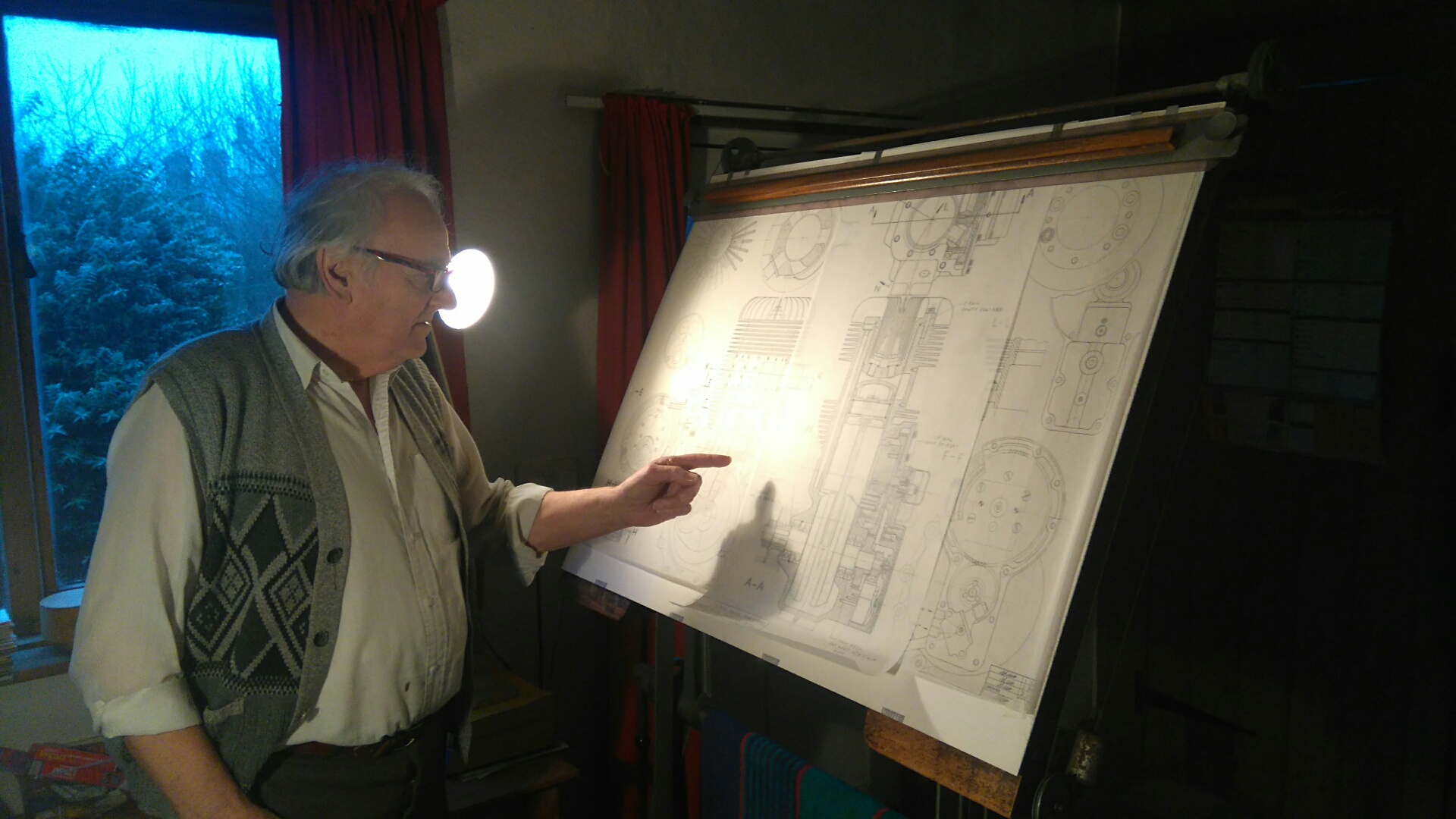
Bob called round the other day for a talk about engines, to see if I’d digested all the info he left over Christmas. I had as it happens, but understanding how things work isn’t my issue. I was working up to asking for some help with the drawing board. I haven’t used one since TD in school, some 30 years ago!! I’d have less of a challenge doing a design in CAD, but the software can be expensive.

We ended up around Bob’s drawing board to look into a few design issues. Bob’s sleeve valve drawings were up and we talked about which aspects we could incorporate, and those we’d need to change. We also had the Bristol drawings to hand which was very useful. It was a great way to spend the afternoon, he’s a good guy to bounce ideas off and we worked well together.

Items for consideration were briefly :

Driving the sleeve will probably be by chain, as the sleeve drive runs in the same direction as the crankshaft on the Hercules. Using a geared drive as per Bob’s engine would reverse the direction, which won’t do.

The gas flow through the Hercules is from rear to front, along the axis of the crankshaft. When fitted to a bike the gas flow will be from side to side, as the crank will have been turned through 90 degrees. This is unfortunate as it would look nice being more conventional, but designing in a bevel to swing the sleeve drive through 90 degrees would make it very complex.

It all looks doable, as long as I can source the parts! Just before I left, Bob asks me "Would you mind if I start drawing it up full size?". Would I?! Of course! I’m honored to have him fully on board for the project!!

New bench – almost!

Standard

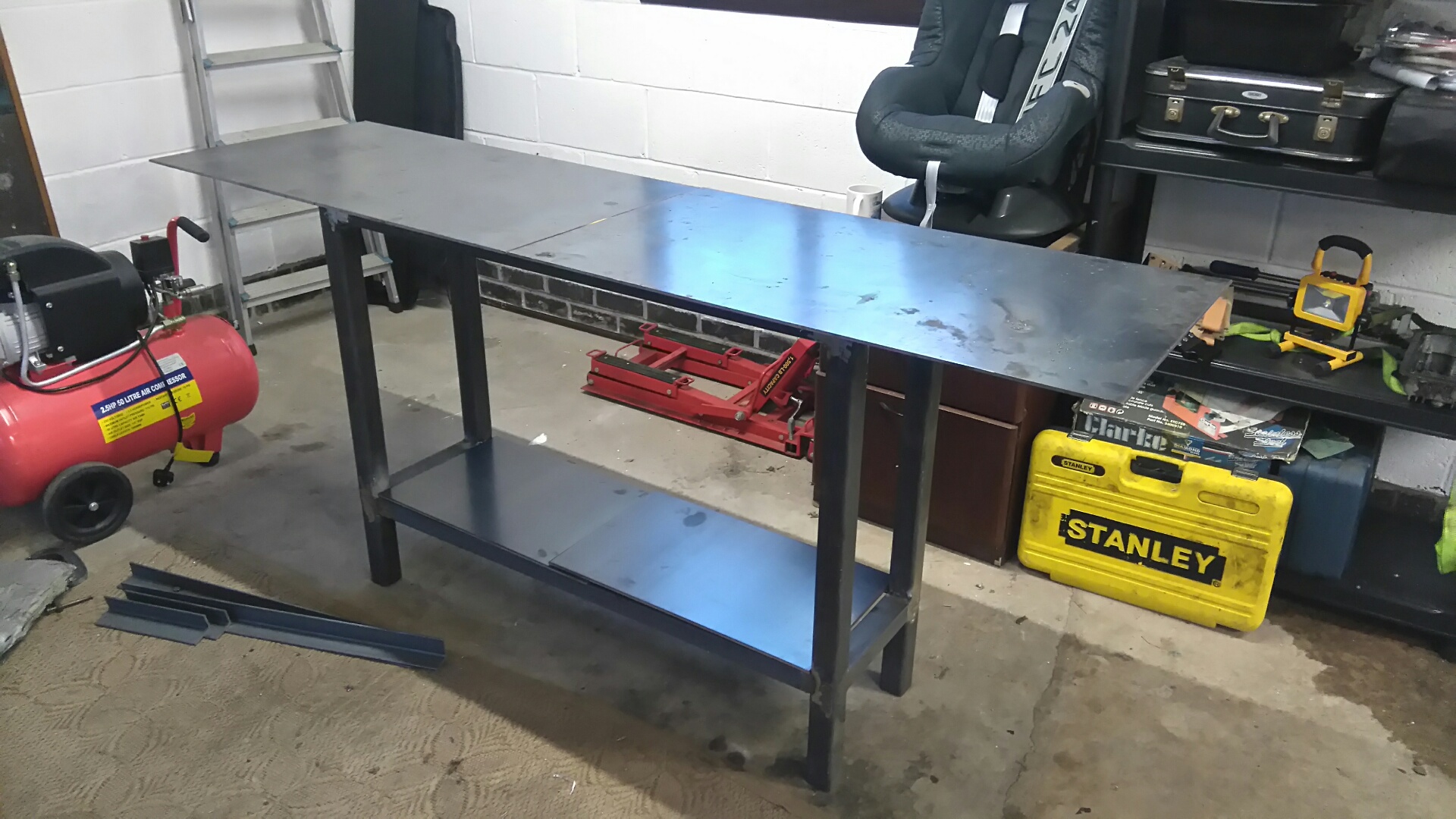
A couple of friends came round today to help me put a new bench together. It was a great day as time in the garage is limited, but so much more productive with a little help. It wasn’t ideal as we ran out of gas for the Mig, so used my stick welder for the base. I think it still looks pretty good though.

Rather than rush it, we decided to leave welding the top until we’ve got gas. The plan is to take it all to a friends workshop where it’s all there ready to go. The finished product will be that little bit better, and as the basis for everything else – why not??

It’s something I’ll only do once (hopefully!), so let’s do it right.

And in other news, what a weekend it’s been for hearing from old friends! I’ve had a few emails from people around the world, some I really didn’t expect to hear from. Maybe the new year is a catalyst for reaching out? Either way, it’s great to hear people’s news. I will be replying in due course!

TLC for NYE.

Standard

Happy New Year! I’m not sure who that goes out to, but anyone reading this is welcome to it.

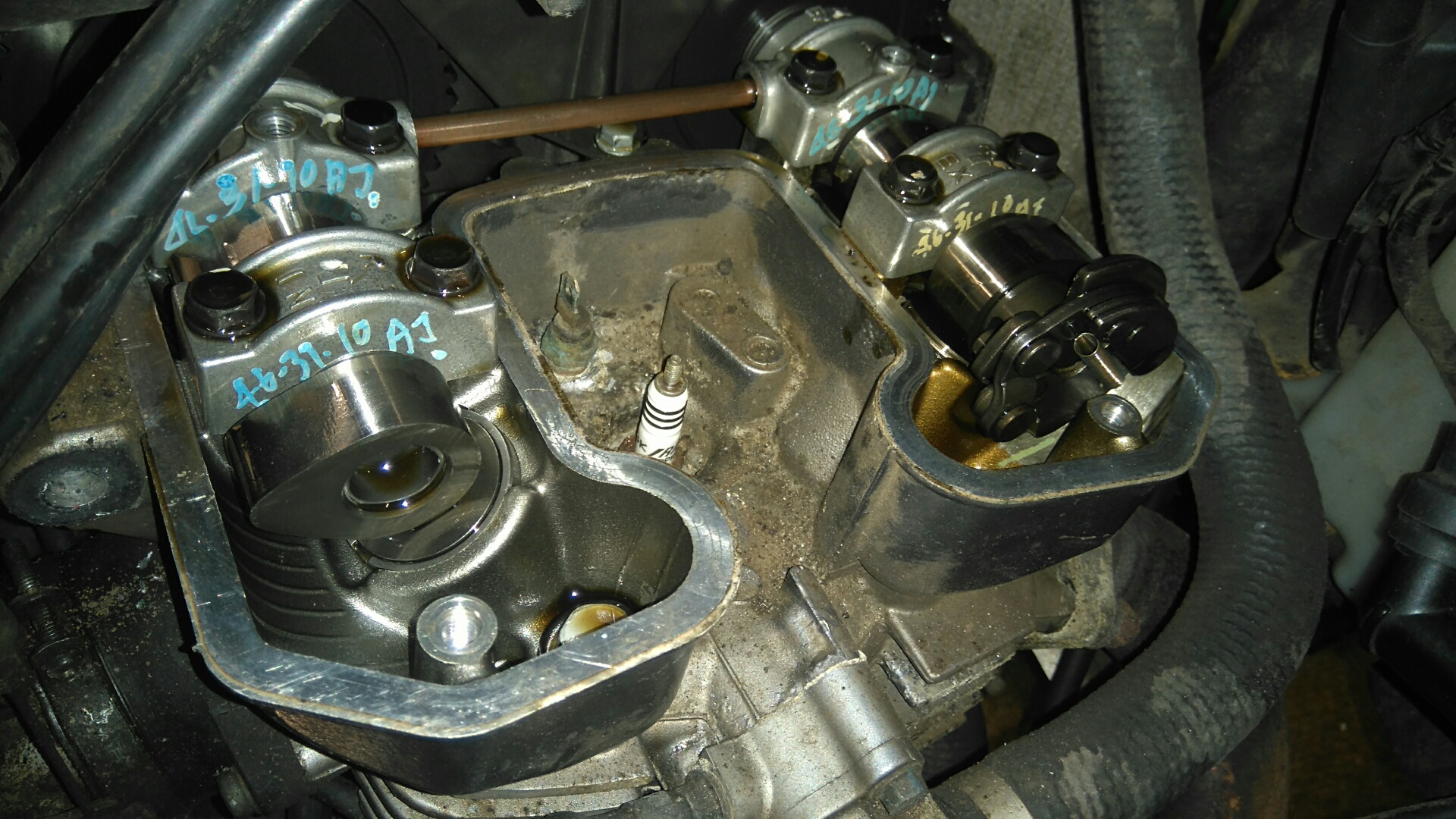
I spent some time last night checking the valve clearances on the KLR. She’s done 68,000 km so long overdue for a check. Finding the time when it’s daily transport isn’t easy, especially for jobs that can "wait another day".

I’m glad I did! Looks like I just caught it in time. Exhaust valves are really tight and out of tolerance, so I’ll need to replace the shims. That’s a cams out job, with re-timing afterwards. It’s pretty straightforward really.

Considering the hard slog the bike’s been through, its holding up really well. A testament to Robust design and good manufacture, though I expect routine maintenance is also a factor.

An unexpected bonus is that simply being inside an engine is helping me make design decisions for mine. Duplex chains running in an oil bath last very well, and a self adjusting chain tensioner makes maintenance easy. I’m almost certainly going for a gear driven sleeve drive, but it’s always good to be reminded of other options.

But back to the job in hand, time to pop those cams out and order some shims!!